
Sandra Pertot
Out in the open
Now we know that Australia’s public broadcaster, the ABC, refused to publish an opinion article by Sall Grover, who is fighting for the rights of women and girls in the Giggle for Girls v Tickle case. As disturbing as the Grover-ABC debacle is, the fact that it has played out in public provides an insight into the way the transgender ideology power dynamic works.
The story begins in 2013 when the Gillard Labor government amended the Sex Discrimination Act by removing the biological definition of sex and introducing “gender identity” as a protected ground against discrimination.
These changes created the legal fiction that a man can be a woman if he says he is.
As a result, in 2026 all three justices in the latest round of the Giggle v Tickle case rejected Ms Grover’s assertion that she was excluding a man from her female-only social media platform, rather than discriminating against a trans woman. The judges expressed their view that in Australia “ordinary usage” of language accepts that a man who presents as female, with or without surgery, has become a woman.
This claim is, in my view, extremely shaky. To start with, the voices of ordinary women who disagree with this belief are suppressed by the type of action being dealt with by the court: ordinary women are punished if they assert in any public place that a woman is an adult female human. Ms Grover is just one example. Others include Kirralie Smith, who is being sued for correctly identifying the sex of male football players competing against females, and Jasmine Sussex, who made the public comment that men can’t breastfeed.
This alone distorts any assessment of “ordinary usage”, which becomes heavily skewed by the loud voices of trans activists.
There is evidence to support the view that ordinary people know a man cannot be a woman. A 2023 survey by the media website news.com.au asked 50,000 Australians 50 questions about a range of controversial topics.
Question 18: Should transgender athletes be allowed to compete in women’s sport?
No: 82.6 per cent
It depends on the sport: 8.2 per cent
I don’t know: 4.9 per cent
Trans women are women: 4.2 per cent
This undermines the view that the general community accepts that a trans woman is a woman.
Further, many trans people do not believe they change sex. Public advocates for trans rights like Caitlyn Jenner, Buck Angel and Chaz Bono openly acknowledge that they have not literally changed their biological sex. Caitlyn Jenner goes so far as to state that trans women are not “real women”.
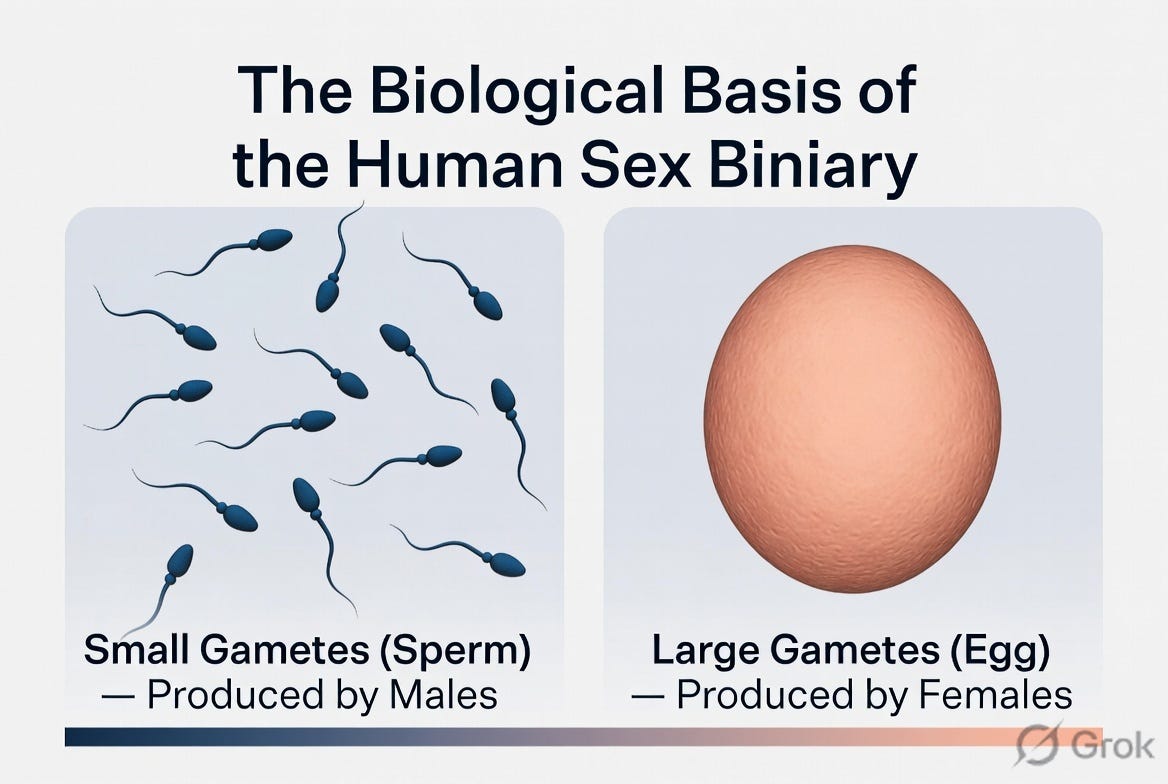
Binary: evolutionary biologist Dr Colin Wright explains the nature and importance of reproductive sex
It’s more than academic
One would think that a female Australian university academic with a special interest in sex and gender would have a good grasp of the basics of biological sex and the history of feminism in Australia.
Yet Professor Paula Gerber, an academic lawyer at Monash University in Melbourne, decided to share her wisdom in an article published on the ABC site with the provocative title: “Why the Giggle for Girls v Tickle judgement is good for trans rights and women’s rights”.
In her view, “the judgement is also a victory for women’s rights. Feminists have long been fighting against the patriarchy that perpetuates gender stereotypes around how we should look and behave. We know that that sort of scrutiny makes every woman more vulnerable to the policing of our bodies.”
This claim is so wrong, so bizarre, especially coming from a lawyer who claims to be a champion of female rights, that it cannot, in my view, simply be a matter of opinion but a misrepresentation of historical facts. Professor Gerber wants us all to ignore the gains of second-wave feminism in the 1960s–1980s, which fundamentally reshaped society by challenging traditional gender roles and pushing for women’s autonomy from the wants and demands of men. Among other major gains, this women’s movement shattered the traditional bio-essentialism views that women are the “weaker sex” and are more emotional, less competent and intelligent than men.
Both sexes benefited from the breakdown of rigid boundaries for female and male appearance, clothing, workplace roles, and so on. Many women abandoned the uncomfortable nylon stockings in favour of bare legs (not the trivial revolt it may seem now). They stopped wearing makeup, began wearing more comfortable loose clothes in place of fitted dresses. Females were given access to education for a range of occupations, previously seen as unnecessary since women were destined to be full-time wives and mothers. And it became more acceptable for women to enter traditionally male work roles such as truck driving, the trades, engineering, and so much more.
The accepted way for men to dress became more relaxed, and my recollection is that males faced far more negativity when they started breaking rules. The drama created by the Beatles hairstyle and the new trend for men to wear coloured shirts seems unbelievable now, but it was intense; I was there. Entertainers like Boy George and David Bowie drew significant criticism but were instrumental in challenging male stereotypes at several levels beyond clothing. It became acceptable for men to enter traditionally female roles such as nursing, childcare, and flight attendants.
One outcome of this liberation of women was that the academic discipline of “gender studies” became rather superfluous. The obvious question is whether academics like Professor Gerber had to find new areas of debate and controversy to justify their ongoing relevance: the “men can be women” movement, which fortuitously emerged at just the right time, the 1980s, opened up a whole new area of controversy and research.
The ABC of censorship
The real champion of female rights, Sall Grover, approached the ABC to respond to these disputed issues asserted by Professor Gerber. In Ms Grover’s initial draft article, she argued that expanding trans women’s rights infringes upon women’s sex-based rights and fails to acknowledge the biological reality of trans women as male. Ms Grover criticised legal developments, specifically in the Giggle v Tickle case, for favouring gender identity over the material rights of biological women to single-sex spaces. Her full article was subsequently published in The Australian newspaper.
Significantly, a senior editor at the ABC had described Ms Grover’s original draft as “very, very good”. Despite that, and after many revisions, the ABC’s Editor of the Religion and Ethics website canned the article on the following grounds: “pervasive inaccuracies” in Ms Grover’s presentation of the Sex Discrimination Act and Giggle v Tickle, as well as “overstatement” about the extent to which changes to the Act present a threat or danger to women and single-sex spaces.
Ms Grover’s use of language such as “biological fact”, “truth” and “material reality” was a “problem”, according to the ABC editor, because of the “high likelihood of alienating and offending the very people I would imagine you are hoping to convince”.
Ms Grover asked for clarification of these claims, but none was forthcoming, which I interpret to mean the editor had no grasp of the issues that Ms Grover was describing and no factual evidence to justify why the article was rejected. I also note that while offending trans people is not acceptable, offending women is perfectly fine.
It seems females having their rights limited to suit a group of males who can claim to be women is insignificant. Talk about a return of the power of the patriarchy!
The fact that there is zero evidence for Professor Gerber’s claims brings me to a very sobering point: if supporters of trans ideology will manipulate history to this extent to suit their narrative, what other “truths” are they consciously and deliberately creating? Indeed, the defining characteristic of any attempt to obtain clarity and evidence for many of the claims made by trans advocates is name calling and punishment in place of hard evidence.
Extraordinary claims
When did it become possible for a man to be a lesbian?
Throughout human history, sex with someone of the same sex (homosexuality) rather than heterosexual sex has been known and was certainly not rare.
Anthropological, historical, and biological evidence indicates that no culture in human history has been entirely without members who experience same-sex attraction. While societies have vastly different ways of defining, accepting, or regulating these behaviours, same-sex desire and relationships are a recognised part of the human experience across all populations.
Suddenly, in the 1980s, a small group of people in the Western world decided not only that a man can be a woman, but that being gay, homosexual, is not same-sex attraction but same-gender attraction. This was part of the agenda of the queer theory movement to break down what they regarded as the heteronormative, male/female binary stranglehold on sex, sexuality and gender.
I say “suddenly”, because in 2024 when I was writing an article on the Australian Human Rights Commission there were two definitions of lesbian on their website, which indicates just how recent and sudden the change was—
Back then, according to the commission sexual orientation “refers to a person’s romantic or sexual attraction to another person, including, amongst others, the following: heterosexual, gay, lesbian, bisexual, pansexual, asexual or same-sex attracted [Emphasis added].”
Now the commission claims that sexual orientation “is understood to refer to each person’s capacity for profound emotional, affectional and sexual attraction to, and intimate and sexual relations with, individuals of a different gender or the same gender or more than one gender [Emphasis added]”.
In the same way that any opposition to the “men can be women” claim is punished, any disagreement with this new definition of sexual orientation leads to punishment.
How did they gain this power? They traded, and continue to trade, on the image of the poor gender-confused, sexuality-confused young people who will self-harm if they aren’t “affirmed”.
More significantly, over time, trans advocates have gained positions of power. The current Sex Discrimination Commissioner Dr Anna Cody is a true believer that a male/man can be a woman and a lesbian. As well as Ms Grover’s case, Dr Cody intervened in the case involving the Lesbian Action Group when they wanted to hold public lesbian events in Victoria that exclude males who claim to be a lesbian.
Intellectual malpractice
There is the same pattern of manufactured claims in the health professions. Where is the evidence that a child “knows” they are the other gender/sex (these terms continue to be conflated when it suits)? Where is the body of research that reveals this? Claiming that affirmed children are happier doesn’t meet the criteria of rigorous research.
A man can be a woman? How and by what criteria?
Health professionals should be on the front line of the fight to restore biological reality across our society, safeguarding children from irreversible changes to their bodies and supporting female sex-based rights.
Instead, these ideological claims are forced onto health professionals by the same pattern of bullying and punishment noted above, as the cases of Dr Jillian Spencer1 and Dr Andrew Amos demonstrate. It is time to change the dynamic and make the health associations accountable for their claims and demands.
It came as a shock to me to find that many if not all health professional associations embrace trans ideology and will not accept any comments that challenge their position. My disillusionment came about some years ago when I noticed the Royal Australian College of General Practitioners (RACGP) had this definition of sex on the website—
“A person’s assigned sex at birth, determined by sex characteristics observed at birth or infancy. A person’s sex can change over the course of their lifetime and may differ from their assigned sex at birth.”
Naively I contacted the RACGP to suggest they add the explanation that only individuals with specific Disorders of Sexual Development (DSDs) can appear to change sex, because as the college’s definition stood, it implied anyone could change sex. It stunned me that after a few email exchanges they told me to stop contacting them; they were confident in their definition.
The following quote from the Royal Australian and New Zealand College of Obstetricians and Gynaecologists (RANZCOG) gives a good summary of the position that health profession associations promote—
“[This New Zealand draft law] would define ‘woman’ in law as ‘an adult human biological female’ and ‘man’ as ‘an adult human biological male’. RANZCOG’s submission explains that this is not a scientifically or clinically accurate description of human sex, which is a complex product of chromosomes, genes, hormones and other factors that exists on a spectrum rather than as a strict binary. Around 1–2 per cent of people have intersex variations or differences of sexual development that this definition fails to account for.”
These irrational beliefs are also taught in some tertiary education departments of health and, worryingly, in the biological sciences. How can any health profession, but especially one whose area of expertise depends on knowing the difference between a woman and a man, possibly justify this position? Further, disorders of sexual form and function are not natural variations any more than a child born deaf or blind has a natural variation in hearing or sight.
This is the brick wall facing health professionals who know that a woman is an adult human biological female. Denial of biological reality underpins all of these gender ideology claims, including their justification for “gender-affirming” interventions for children and adolescents.
Call to action
Those of us who know that biology is what makes us human and determines our sex need an action plan. Professional associations and university departments that promote the dogma that biology doesn’t matter must be held accountable, despite any determined efforts to silence dissent.
I propose that these associations and education bodies are flooded with demands that they answer the following questions—
1. Why is there a human characteristic called sex? What is its form and function?
2. If sex isn’t binary, what are the other sexes?
3. What role do these other sexes play in reproduction?
4. If a person with a DSD is fertile, do they produce gametes that are neither sperm nor ova?
5. If sex is a spectrum, how does sex change across the sex dimension from XX to XY?
6. Setting aside individuals born with a DSD, outline the process by which a man (a human born male) becomes a woman (a person born female)? What biological parts and functions change?
7. Women know they are women because they are adult female humans – what criteria does a man use to decide he is a woman?
8. Do all trans women use the same criteria?
9. Can a person with a penis be a woman? A lesbian?
10. How would you explain to a child how babies are made?
I encourage anyone—health professionals, concerned parents, schoolteachers, anyone—concerned that some health professionals deny biological reality, to contact the relevant health association or state health service. The various associations and health departments are easily found on the internet and usually have a position statement that outlines their opinion of biological reality, as well as contact details.
For example, the emails for RANZCOG are ranzcog@ranzcog.edu.au and ranzcog@ranzcog.org.nz.
We must dispel the illusion that only a silent minority acknowledges the reality that sex is binary and immutable.
Dr Spencer has reached a settlement with her former hospital—including a statement in which the hospital recognised her professional right to critique the “gender-affirming” treatment model—but it came at the cost of her job.
TRANSWOMEN ARE SEXUALLY ABUSING THEIR CISGENDER SISTERS
Globally Trans Women (assigned male at birth) account for around 80% of self-identified transgender prisoners.
The WA government recently blocked an attempt by a violent prisoner who had ‘transitioned’ to female while serving a life sentence in a men's facility from transferring to the Bandyup Women's Prison.
He had begun hormone therapy after being incarcerated as a man.
. . . . The UK MOJ statistics from March/April 2019 (most recent official count of transgender prisoners):
• 76 sex offenders out of 129 transwomen = 58.9%
• 125 sex offenders out of 3,812 women in prison = 3.3%
…. The logic and safety of Australia’s anti-discrimination law that demands trans women have the legal right to use women’s restrooms and change facilities aligning with their affirmed gender identity demands a rethink.
Sandra
This is clear and comprehensive. I thought I knew a lot about this issue, but this part absolutely astounded me:
“The Royal Australian College of General Practitioners (RACGP) had this definition of sex on the website—
“A person’s assigned sex at birth, determined by sex characteristics observed at birth or infancy. A person’s sex can change over the course of their lifetime and may differ from their assigned sex at birth”