


Approved, until it wasn’t
A talk to familiarise Australian family doctors with a safer treatment approach to youth gender dysphoria will not go ahead as planned after a medical college buckled to activist pressure.
The well-subscribed March 10 webinar presentation by Finnish psychiatrist Riittakerttu Kaltiala—a leading clinician and researcher in the international shift away from routine “gender-affirming” medicalisation of minors—had been approved and advertised since the New Year by the Royal Australian College of General Practitioners (RACGP).1
(UPDATE | Professor Kaltiala said the conduct of the RACGP was not “appropriate and polite,” The Australian newspaper reported on March 7. “It is obvious that there are parties who want to control what Australian GPs hear.”)
GP Louise Kirby, who was among the more than 200 subscribers who signed up for the RACGP event, told GCN—
“We’ve reached a point where presenting outcome data is called harmful, and where speaking out to protect children from irreversible, damaging interventions is incorrectly framed as an attack on children. That inversion should alarm every clinician”.
Professor Kaltiala set up paediatric gender services in Finland 15 years ago on the strength of promising results reported by the famous Amsterdam gender clinic, which pioneered the puberty blocker-driven “Dutch protocol” of gender reassignment for minors.
But Professor Kaltiala and her colleagues were confronted by quite a different group of often psychiatrically troubled adolescent patients—chiefly female adolescents with no early childhood history of gender dysphoria—who did not do well after medical transition.
This poorly understood shift in patient profile would become dominant internationally, including in Australia.
In 2020, following a systematic review of the evidence, Finland became the first country to adopt a more cautious treatment policy, declaring medical reassignment for minors “experimental” and prioritising mainstream mental health interventions.
Professor Kaltiala’s webinar for the RACGP was approved, and doctors attending could count this learning activity towards their “continuous professional development” (CPD).
On March 3, subscribers to the webinar—titled “Medical gender reassignment among minors: why are we cautious in Finland”—received an automated reminder about the event.
But members of the activist group GPDU for Gender-Affirming Healthcare, which has transgender activist Teddy Cook among its administrators, had already been orchestrating complaints about the Kaltiala webinar and sharing the email address of RACGP president Michael Wright.2
One GPDU member posted: “This is one of those situations where volume of concern (i.e., multiple individual complaints) would be considered helpful … If you struggle to write letters, I am happy to email you what I wrote”.
The network of the gender medicine lobby, the Australian Professional Association for Trans Health (AusPATH), was also mobilised against the webinar. The email of the RACGP’s chief executive, Georgina van de Water, was circulated.
Complaints to the RACGP claimed the webinar showed “hostility to trans people”, would imperil “patient safety”, expose the college to a backlash and damage its reputation.
The title of Professor Kaltiala’s presentation mirrors that of a peer-reviewed article in which she explains Finland’s shift to caution. She has also written about this for The Free Press.
The RACGP webpage for her March 10 talk had included a trigger warning—
“This webinar will discuss sensitive topics related to gender identity in young people, including differing clinical perspectives and international treatment approaches in order to assist GPs to make their own evidence-based decision.
“Some content may be challenging for attendees. Please engage in ways that feel comfortable for you”.
Disappearing act: The RACGP webpage promoting the Kaltiala talk
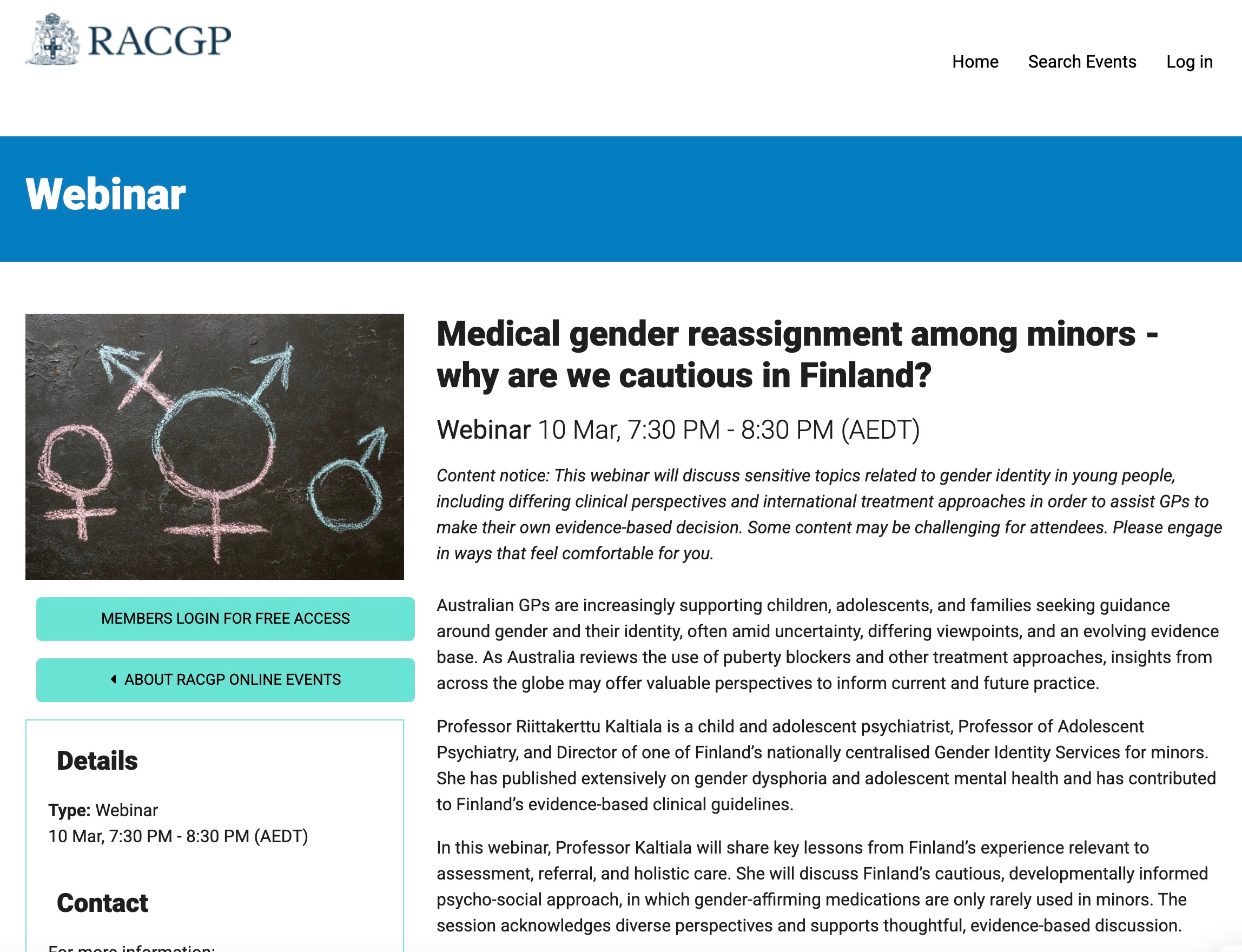
Change of heart
On March 4, an email from the RACGP announced a “postponement and format change”, insisting the webinar had not been cancelled.
Citing “constructive feedback” and “many strong views held from across the RACGP membership”, the college said it had decided—
“… this topic would be best redesigned as a panel discussion, which will allow us to holistically engage with the sensitivities and nuance associated with transgender and gender-diverse healthcare”.
No details on timing or panel membership were given. There was no undertaking that Professor Kaltiala would be included.
On the RACGP webpage advertising the Kaltiala talk, her name and the outline of her presentation have been removed. The title of her session remains.
A March 4 update note from Associate Professor Jeremy Hudson, who chairs the specific interests council for the college, says: “This topic should not be cancelled. It is complex, evolving and important. A panel discussion will allow a broader range of expertise, a stronger evidence base, and a safer environment for professional dialogue.”
“Redesigning this session means identifying appropriate panel members and refining the format. This will require a delay and we will share a new date once confirmed.”
Gender-affirming clinicians and trans activists have a track record of refusing to debate their critics, smearing them as “anti-trans” and saying they would feel “unsafe” to share a panel with them.
On March 6, subscribers to the Kaltiala webinar were sent an automated message that it had been “cancelled”.
Double standard
The RACGP has promoted the gender-affirming model without alerting doctors to critiques or less invasive treatment approaches.
In June 2025, a learning activity worth five hours of CPD was offered on “Gender and gender diversity”.
“The purpose of this activity is to demonstrate how general practitioners can positively influence the lives of gender diverse individuals through gender-affirming healthcare,” the CPD webpage says.
The college’s Australian Journal of General Practice has published articles uncritically advocating for gender medicine. AusPATH’s fast-track “informed consent” guideline for hormones is recognised as an “accepted clinical resource” by the college.
The gender-affirming treatment model has been shielded from critical inquiry and scepticism internationally by activist capture of small policy-making committees in medical associations, one-sided media coverage, low-quality treatment guidelines exaggerating the scientific evidence for the model, and the silencing of dissenters as purveyors of “hate”, “bigotry” and “transphobia”.
This creates a deceptive appearance of medical consensus in favour of puberty blockers, cross-sex hormones and surgery for young people.
Suppression: Oxford University sociologist Michael Biggs on the emergence of the very novel idea that puberty is a disease, even “torture”
Expertise withheld
Dr Kirby, who was among the doctors hoping the Kaltiala webinar would go ahead, characterised her own position as opposing “medical and surgical interventions on children and adolescents confused or distressed about the natural process of puberty”.
She said she and her GP colleagues had been denied the benefit of learning from the experience of Professor Kaltiala as “a world-class clinician”.
“Replacing a world-class, evidence-based speaker with a ‘panel discussion’ isn’t balance. It is effectively a veto,” Dr Kirby told GCN.
“The RACGP has signalled that activist pressure outweighs clinical evidence.
“Finland reviewed its own evidence and changed course. Australian doctors registered in large numbers to hear why. The RACGP’s response was to shut that conversation down. What exactly are they afraid GPs will conclude?
“Primum non nocere—First, do no harm—cannot be practised by doctors who are forbidden from examining evidence of harm. Silencing Dr Kaltiala under the pretence of a postponement and panel creation doesn’t protect patients. It protects a treatment model from scrutiny.”
The gender medicine lobby sees the family practices of GPs as vital to expanding and mainstreaming cross-sex hormones for teenagers, given the long waiting lists for children’s hospital gender clinics.
In Queensland, where the government has stopped new hormonal treatment in the public health sector, GPs are being recruited to prescribe puberty blocker drugs for children.
Not all members of the gender-affirming GPDU group were opposed to hearing from Professor Kaltiala. One member posted: “I feel clear about what my position is and feel like I could effectively articulate why I disagree with the approach [advocated by Professor Kaltiala]”.
Professor Kaltiala is chief psychiatrist at Finland’s Tampere University Hospital and professor of adolescent psychiatry at Tampere University. She is a prolific researcher in the field of youth gender dysphoria.
GCN sought comment from her and put questions to the RACGP.
General practitioners, GPs, are family doctors working in primary care.
GCN is not suggesting that Cook took part in the pressure campaign directed at the RACGP
Science is not ideology.
THE 1% CLAIMED TRANSITION REGRET RATE IS NONSENSE
The the oft quoted claim that ‘regret following gender transition was less than 1%’ was the claimed finding in a 2021 paper titled: ‘Regret after Gender-affirmation Surgery: A Systematic Review and Meta-analysis of Prevalence’
The paper which covered 27 studies and 9,700 subjects did not report a single universal mean-time since transition but did note that the study cohort had undergone ‘transition’ from 0.8 year to 9 year earlier’ and that ‘many of the studies were limited by short follow-up periods (1-2 years)’.
. . . Clearly, the ‘less than 1% regret rate’ claim is unscientific and a clinician advising a patient or parent of this statistic would be misleading them.
I list a random selection of multiple quotes from the obvious regret cited in studies from the poor souls who have defied the 1% regret rate:
• Suicide risk remained elevated throughout all transition stages, with little long-term improvement
• Hormone-treated individuals experienced persistently increased mortality risk over decades.
• Mortality 51% higher than the general population, linked to suicide, cardiovascular issues, and substance abuse.
• Lower scores across general health, physical function, and social role domains.
• Surgical patients had significantly elevated rates of depression, anxiety, suicidality, and substance use disorders