


Psychology first
Only 5 per cent of people polled in the Netherlands—home to the puberty blocker-driven Dutch protocol for paediatric medical transition—support the use of these drugs as the primary response to gender-distressed youth.
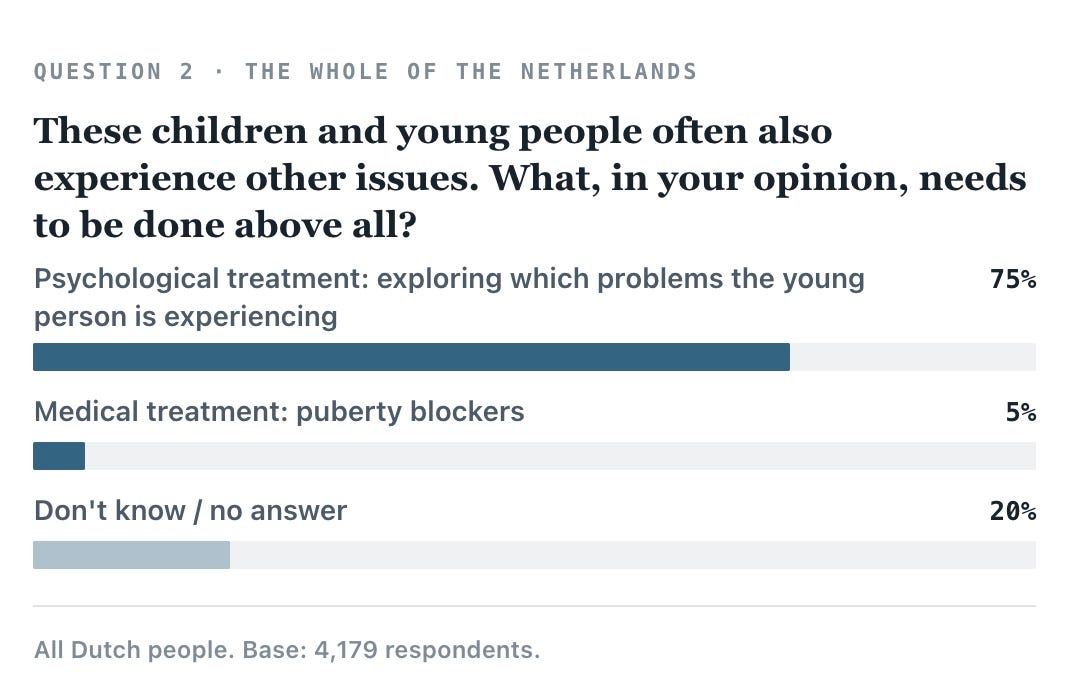
Of six questions on paediatric medical transition put to 4,179 voters, a preference for psychological treatment (75 per cent) over puberty blockers was the only common ground across political party affiliation, according to pollster and entrepreneur Maurice de Hond. One in five people simply did not know what was best.
“Support for the medical approach [by political allegiance] does not exceed 15 per cent anywhere,” Mr de Hond wrote on his website. That figure of 15 per cent was from loyalists of the progressive-left PRO party.
For this question, respondents were told that minors with gender dysphoria “often face other issues as well”.
“In children with gender dysphoria, other issues often play a role as well, such as autism, depression, or trauma,” Mr de Hond said.
Council vetoed
A representative sample took the survey in late July to early August, after the Health Council of the Netherlands issued its June 30 report. The council acknowledged the weak evidence for the Dutch protocol but claimed there was no reason to restrict puberty blockers or cross-sex hormones because, based on treatment guidelines, their delivery was carefully organised.
A new, revised Dutch guideline for hormonal treatments is to be aligned with the 2022 standards of care (SOC-8) from the World Professional Association of Transgender Health (WPATH). Authors of SOC-8 include prominent Dutch clinicians such as psychiatrist Dr Annelou de Vries and clinical psychologist Dr Thomas Steensma.
Defending itself against US legal action for allegedly false and deceptive conduct, WPATH has argued that its standards are simply one opinion in a contested debate, no longer the gender gospel of the “science is settled” era.


Dutch courage
The new Dutch survey was commissioned by the authors of a June 25 opinion article in the newspaper Trouw calling for the Health Council to inquire deeply into the foundational assumptions of the Dutch protocol. The authors constitute a broad group, with clinicians and ex-politicians including Pieter Omtzigt, founder of the centrist New Social Contract party.
On the survey question whether doctors can predict the stability of a minor’s wish for a gender change, 30 per cent of respondents said No, with 23 per cent Sometimes, 19 per cent Yes, and 11 per cent Don’t know.
The question was dismissed as irrelevant by 17 per cent who insisted that a change of sex is not possible.1
Mr de Hond said the persistence of a cross-sex identity “goes to the heart of the medical debate: can doctors reliably predict whether a child’s desire to change gender is permanent? Only 19 per cent of the Dutch population believe they can.”
Told that “Puberty blockers, hormones and subsequent operations can have lasting physical consequences”, respondents in the de Hond survey were asked what they made of these interventions.
They were pointless, according to 44 per cent, because “No one can truly change their sex.” Just over a quarter of those polled agreed these interventions “can help the body achieve the desired appearance”. Three in ten did not know or did not answer.
For this question, respondents were “presented with the potential physical consequences: effects on bone development, fertility, the cardiovascular system and brain development, and subsequent complications following surgery”.
Mr de Hond said: “The political divide is sharpest here: 59 per cent of PRO voters and 57 per cent of [centre-left] D66 voters see it as a way to achieve the desired appearance”.
By contrast, 81 per cent of those supporting the radical-right FVD party held the view that sex cannot be changed; only 6 per cent of PRO voters agreed with this proposition.
Respondents with higher education and those under age 35 were more likely to embrace medical interventions as a means to attain “the desired appearance”.
The poll also tested competing values with the question, “The evidence regarding the outcomes of these treatments is uncertain. Which factor should be given the greatest weight?”
Just over a third of respondents opted for “Preventing [minors] from receiving treatment too early that could have lasting consequences”.
The next largest group, 28 per cent, agreed with “Helping [minors] to accept their bodies and their sex”. Next, 24 per cent chose the aim of “Preventing [minors] from waiting too long for help that might be beneficial”. In effect, Mr de Hond said, almost two-thirds had adopted a cautious response.
“A difference between men and women is also evident on this question: women are more likely to opt for preventing premature treatment (41 per cent versus 32 per cent), whilst men are more likely to opt for acceptance (32 per cent versus 26 per cent),” he said.
Publicist Geert-Jan Edelenbosch, one of the authors of the Trouw opinion article and a former coordinator of the youth and education program at the LGBTI organisation COC Nederland, said the de Hond poll was not asking the public to settle a medical question.
“Against the background of the uncertainties acknowledged by the Dutch Health Council itself, the survey shows that a clear majority of Dutch people prefer a more precautionary response than the council does,” Mr Edelenbosch told GCN.
“That matters because the remaining choice is not simply scientific: it is also about how much uncertainty and risk of lasting harm we are prepared to accept when treating children.
“The underlying problem, as I see it, is this: without a reliable prognosis, a doctor cannot know which possible future he is protecting—that of a young person who will later want medical transition, or one in which the distress diminishes and the young person comes to experience their body differently.
“Medicine can investigate the consequences of either course, but it cannot determine on scientific grounds which future should take precedence. That is why this cannot be treated as a purely medical or scientific question.
“It is also a societal and moral debate about which risks we are prepared to accept, which interests of children deserve protection, and how we should act when the evidence cannot resolve the choice for us.”
On the survey question whether parents should have the right to refuse puberty blockers or cross-sex hormones for their child, agreement was strongest (63 per cent) in the age group (45- to 54-year-olds) most likely to have children still living at home.
Two-thirds of respondents answered Yes to the question “England, Sweden and Finland have become much more cautious about these treatments. Should the Netherlands follow suit?”
Even those who vote for the left-leaning PRO and D66 parties did not constitute majorities opposed to this precautionary, less medicalised posture.
These are significant results because the famous Amsterdam clinic presents itself as more cautious than the overseas adopters of its Dutch protocol for gender medicalisation of minors.
The protocol and its key 2011 and 2014 papers have more recently come under sharp scrutiny, and there have been anecdotal reports that clinical practice in the Netherlands does not live up to the seeming caution of its treatment guidelines.
“Across the six questions [in the poll], two distinct trends emerge,” Mr de Hond wrote. “The first is a sharp political divide, with PRO and D66 on one [left] side and JA21, PVV and FVD on the [right], whilst the CDA and VVD are closer to the right-wing bloc than to the centre.
“The second [trend] runs along the lines of education and age: those with higher levels of education and younger people have greater confidence in the medical approach, whilst those with lower levels of education and older people have considerably less.
“These two lines reinforce each other, but do not dominate everything: when asked what should actually be done, a large majority in virtually every group opts first for psychological support.”
In Dutch, the term Geslacht usually means sex, with Gender used as a loan word from English. The de Hond survey uses Geslacht, while gender dysphoria appears as Genderdysforie.
Just over a third of respondents opted for “Preventing [minors] from receiving treatment too early that could have lasting consequences”
Those ‘lasting consequences’ are well illustrated in the huge burden of dreadful health outcomes in the US:
….. US Transgender women have a HIV prevalence around 50 times that of the general adult population (WHO)
…. Long-term post transition studies indicate HIV prevalence is approximately 20% for transgender women and 2.6% for transgender men. (CDC)
….Transgender women have disproportionately high rates of gonorrhoea, syphilis and HIV (CDC)
….Transgender men accounted for 0.16% of all adults and 11% of all transgender adults receiving HIV medical care in the US from 2009 to 2014, a multiple of 70 times (US NIH)
…..Transgender individuals face disproportionately high incarceration rates in the U.S. with lifetime incarceration estimates ranging from 16% to over 37% compared to the 2.5% general population rate
….Near one million people (.3%) identify as transgender in the United States and transgender people made up 2% (671) of new HIV diagnoses in the US (CDC)
….US transgender individuals experience near double mortality rate that of cisgender counterpart, driven by factors such as suicide, homicide and accidental poisoning rather than inherent biological differences (NIH).
Even if they feel this way long term, do these medical interventions benefit them long term (the effects are long term)? Or do they do more harm?
There are two questions in my mind...
As far as being honest, soc 8 says:
"Strong recommendations (“we recommend”) are for those interventions/therapy/strategies where:
the evidence is of high quality
estimates of the effect of an intervention/therapy/strategy (i.e., there is a high degree of certainty effects will be achieved in practice)
there are few downsides of therapy/intervention/strategy
there is a high degree of acceptance among providers and patients or those for whom the recommendation applies."
Soc 8 recommends a lot. Even in the adolescent chapter. They did the systematic reviews and then interfered with them. They didn't find good evidence. They don't have high quality evidence. There isn't high quality evidence!
I think the fraud was committed to their (paying) members who believed their soc 8 and who give these treatments based on them.