


GCN global briefs
Shameful Pride
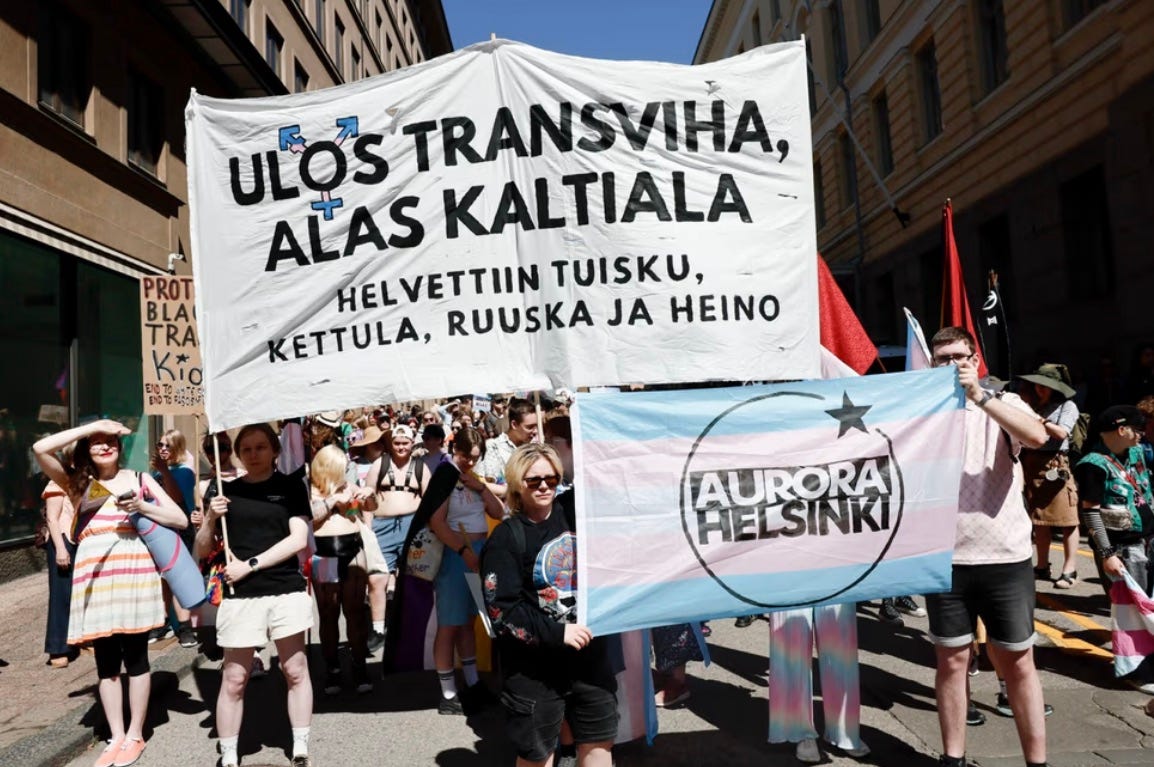
Finland | Pride celebrations in Helsinki at the weekend included trans rights activists holding aloft a banner urging “Out with transphobia, down with Kaltiala. To Hell with Tuisku, Kettula, Ruuska and Heino”. These are the names of Finnish researchers whose scientific work has cast doubt on the dogmas of “gender-affirming care”. A photo of this activist call-to-arms was published by the widely read newspaper Helsingin Sanomat.

“I am horrified that the Pride organisation allows that [personal attack] and Helsingin Sanomat gives it room,” Professor Riittakerttu Kaltiala told GCN.
She and her colleagues had been among the earliest in offering the Dutch protocol hormonal treatments for adolescents from 2011. However, the Finnish clinicians shifted to a less medical, more psychological approach in 2020 after noting the poor outcomes of a troubled patient group significantly different from the Dutch protocol studies.
Professor Kaltiala has emerged as an international critic of the “gender-affirming” medicalisation of minors. Her concerns follow the evidence, including unusually comprehensive studies thanks to Finland’s health registers.
Out with transphobia, etc. Photo from a gallery published by Helsingin Sanomat
Fake news
In a recent article, the Finnish Medical Journal documented cases of “hot-topic” researchers, Professor Kaltiala included, who were targeted for harassment and cancellation. Journalist Heli Väyrynen reported that Professor Kaltiala’s statements had been “distorted”.
“It has been [falsely] claimed that she wants to ban gender-reassignment treatments or regards an identity that diverges from biological sex as a mental health disorder,” Väyrynen wrote. “Activists have tried to influence the organisers of training events and demanded that lectures be cancelled. They have spread lies about her clinic, her work, and her research to Tampere University and [its associated hospital] TAYS.”
“Kaltiala emphasises the correct timing of physical treatments. When gender identity is still forming, a cautious approach is justified because the changes are partly irreversible. Young people coming for assessment who hope for corrective treatment often have serious mental health disorders that cannot be interpreted as caused by gender, so the issue is complex and challenging. They may need other help first.”
Professor Kaltiala told Väyrynen it had never occurred to her that the topic of paediatric transition “wouldn’t follow the same rules as the rest of medicine”. Professor Kaltiala appreciated her university’s measures to support staff coming under activist attack. “I have received thanks from the scientific community and colleagues for raising issues that not everyone dares to speak about,” she said.
Respect the science
America | In a letter to The Wall Street Journal, endocrinologist Dr Roy Eappen, of the watchdog group Do No Harm, has hailed a recent Finnish study on the poor mental health outcomes after paediatric medical transition as “a scientific tour de force”.
“The question now is whether US medical societies will respect the evidence and uphold their ethical obligation,” Dr Eappen wrote. “The American Academy of Pediatrics still unquestioningly supports providing invasive and irreversible medical interventions to adolescents, including hormones and surgeries. So does the Endocrine Society, of which I am a member. While the society is planning to publish new treatment guidelines this year, it’s an open question whether the new version will be grounded in evidence or more ideology.”
“Medical societies have an obligation to follow the science. For the sake of struggling children confused about their gender—to say nothing of the societies’ own reputations and influence—these organizations should use the release of the Finnish study as an opportunity to finally do what’s right.”
Go deeper
Holland | The Health Council of the Netherlands, scheduled to report on paediatric medical transition on June 30, must go beyond the evidence base to scrutinise the assumptions of the Dutch protocol, according to an opinion article in the centre-left newspaper Trouw. The council, asked for advice by the Dutch House of Representatives in 2024, has already referred to its subject matter as “transgender children and young people”. That is problematic, according to the article for Trouw, which was signed by a broad group including clinicians and ex-politicians.
“Is a young person with gender dysphoria someone with a fixed, inner gender identity that needs to be affirmed?” the article asked. “Or is it a matter of discomfort regarding the body, sexual orientation and societal expectations, the origins, meaning and development of which remain open to interpretation?”
“That choice determines how research is interpreted, how diagnoses are made and what care a young person receives. Should the focus initially be on comprehensive assessment and psychological support? Or should the process move relatively quickly towards a medical pathway, with far-reaching and often irreversible consequences for fertility, sexual experience, bone density and lifelong dependence on hormones?
“Gender dysphoria in young people can have multiple causes. It is therefore not sufficient to examine medical outcomes alone. We must also ask: what alternative pathways have been considered? How do young people develop differently without medical intervention? And who actually benefits from a radical medical intervention?”
The opinion article argued that the Netherlands “bears a special responsibility” as the source of the medicalised Dutch protocol for gender transition, and cannot continue to ignore the international shift towards a more cautious, less invasive response to gender-distressed youth.
“It is precisely during puberty that many young people gain greater clarity about their bodies, sexuality and sexual orientation,” the article said. “A longitudinal study from the Groningen TRAILS cohort shows why caution is warranted: feelings of dissatisfaction with one’s own gender were relatively common in early adolescence, but later subsided in a significant proportion of young people. Such findings underline that discomfort regarding one’s gender can change during development and that it is therefore risky to interpret this discomfort too quickly as a fixed gender identity.”
One of the article’s authors, publicist Geert-Jan Edelenbosch, a former coordinator of the youth and education program at the LGBTI organisation COC Nederland, told GCN that the Trouw article was significant because it had appeared “in a serious mainstream Dutch newspaper, just before the Health Council publishes its advice, and with a broad group of signatories rather than from one predictable political or activist corner.”
“Until now, concerns about the Dutch protocol have often been treated in the Netherlands as marginal, ideological, or as something happening ‘abroad’,” Mr Edelenbosch said. “This article helps move the debate into the mainstream: doctors, psychologists, parents, writers and politicians are openly asking whether the evidence base is strong enough for such far-reaching medical interventions in minors.”
Earlier attempts to raise awareness about the shortcomings of the Dutch protocol include a 2023 documentary, the Transgender Protocol, and two opinion articles in NRC by the writer Jan Kuitenbrouwer and media sociologist Dr Peter Vasterman in 2022 and 2024. In 2020, women’s organisation Voorzij put its concerns about the gender medicalisation of minors to a Dutch parliamentary committee.
Mortality as an afterthought
International | The Amsterdam clinic, home of the widely adopted Dutch protocol, has no good basis for its recent claim that, after three decades of research, clinicians can have “more confidence” in the use of puberty blockers, cross-sex hormones and trans surgery. This is the critique of a new paper in the European Journal of Developmental Psychology by psychiatrist Dr Kathleen McDeavitt and J Cohn of the Society for Evidence-based Gender Medicine. The authors said the Dutch research lacked “methodologically robust” designs, and the Amsterdam clinicians had ignored six years of high-quality systematic reviews confirming the weakness of the evidence base.
Child and adolescent psychiatrist Dr Annelou de Vries and her Dutch colleagues had underplayed the risks when relegating the death of one patient in their pioneering study to the “methods” section of a paper, according to the McDeavitt-Cohn paper.
“They did not explain that this death was directly attributable to the penoscrotal hypoplasia caused by [puberty blocker]/oestrogen exposure. Consequently, the mortality associated with the Dutch protocol approach has never been identified as a harm by systematic reviews.”
Domino theory
America | The US Federal Trade Commission (FTC), together with Texas and other states, has begun legal action against the World Professional Association for Transgender Health, claiming that WPATH “has provided the means for medical providers to make false and unsubstantiated claims to parents in order to sell pediatric medical transition services”. The FTC’s 123-page complaint alleges that WPATH’s treatment recommendations “misled parents and children about the medical consensus and medical necessity, as well as the safety and effectiveness, of such services, in violation of the FTC Act”.
In UnHerd magazine, commentator Leor Sapir said an FTC success against WPATH would have knock-on effects. “WPATH has spent the past two decades infiltrating bona fide medical groups such as the Endocrine Society with the goal of getting them to launder its credibility by staking their own on it,” Mr Sapir wrote. “WPATH’s downfall would thus likely trigger a larger collapse, bringing public scandal—and potentially legal and financial liability—to other doctor groups.”
Mr Sapir featured in an X space talk on the litigation, hosted by the group Democrats for an Informed Approach to Gender. In a statement, WPATH protested that the FTC “has no place interfering with the process of individualised medical decision-making and the FTC also does not have any jurisdiction over WPATH and its non-commercial speech”.
Not what you think: British barrister Dennis Kavanagh, a gay man, likens Labour’s draft ban on “conversion practices” to the Margaret Thatcher-era s28 law against promotion of homosexuality.
Criminalising caution
United Kingdom | The ruling Labour Party government has introduced a draft “trans-inclusive” criminal law against “conversion practices” with penalties up to five years’ prison and unlimited fines. A conversion practice could be conduct with the intention of causing someone to “believe that they have or do not have” a particular sexual orientation or trans identity. There is conditional protection for those providing “health care services”, but not for parents.
Bev Jackson, co-founder of the LGB Alliance, said the law would “criminalize a parent who says: ‘No, you’re a boy. Maybe you’re gay. That’s fine: Let’s get you some therapy to explore the causes of your distress’. It will criminalize a parent who says ‘No, I refuse to pay for binders, blockers, testosterone. You’re a girl. It’s fine to be a lesbian.”
US detransitioner Jonni Skinner, a young gay man, said he believed such conversion practice bans were “a work around to solidify the affirmation-only approach to pediatric gender distress into law—[something] which has already and will continue to have catastrophic consequences for gay, gender non-conforming, and other vulnerable youth into the future.”
In the UK Parliament, Labour MP Tonia Antoniazzi asked if the draft law would allow “detransitioners to bring retrospective cases against therapists and professionals who transitioned them using that affirmative approach”.
The parents’ group Bayswater Support said the new statute would “harm the very people it purports to protect by enshrining in law a belief that is inextricably bound up with rejection of the body and psychological distress”. “Individual parents, parent-led support groups like Bayswater Support and healthcare professionals (including the NHS paediatric gender services) continue to be subjected to a barrage of false accusations that they are engaging in ‘conversion’. This draft bill adds the threat of criminal prosecution to those wildly inaccurate claims.”
The Free Speech Union (FSU) has begun a petition against the draft law. “Speech is always curtailed in the name of preventing ‘harm’,” the FSU said. “But stopping parents talking honestly to their children about the risks of irreversible medical procedures will cause actual, real-world harm. This is a fight we have to win.”
Columnist Sonia Sodha saw Labour’s draft law as a device “to smuggle a new concept into criminal law of an undefined ‘gender identity’ that is defined nowhere else in [UK] law, and which pulls against the emerging medical consensus that children and young people don’t have fixed ‘gender identities’, their identities are in flux”.
In her analysis, barrister Sarah Phillimore found no sign that the bill’s drafters had considered its likely effect on the family justice system. In the worst-case scenario, she said, prosecution of parents for a conversion practice could lead to orders for removal of the child, or even all their children.
Thought control
International | A paper by US paediatrician Dr Julia Mason and colleagues has warned that overly broad bans on conversion practices conflate psychotherapy with coercion and put a political chill on normal clinical inquiry. “The case of youth gender dysphoria illustrates how political institutions can shape psychology not only by regulating interventions, but by narrowing the scope of permissible clinical thought,” Mason et al argued in the journal Current Opinion in Psychology.
“When uncertainty is reframed as harm and exploration as misconduct, psychology risks abandoning its foundational commitments to formulation, pluralism, and developmental sensitivity. Preserving space for psychotherapeutic inquiry is therefore not merely a clinical concern, but a disciplinary imperative.”
Inner soul-searching
Germany | The concept of gender identity, claimed to be something that humans have known since time immemorial, is in fact “entirely new”, according to a new book by the American sociologist Rogers Brubaker. His book, Gender Identity: The Career of a Category, has been reviewed in the German newspaper Die Welt under the headline “The invention of ‘gender identity’ and its destructive consequences”. “The concept of gender identity, as Brubaker writes, actually originates from medical diagnostics and referred to a disorder,” Die Welt’s reviewer said.
“By appropriating and redefining the term, transgender activism was in turn able to drive medicine forward, as in the justification for ‘gender-affirming treatments’. The crux of the matter is that perceived gender is now regarded as innate, whilst biological sex is seen as arbitrarily adaptable—a complete reversal of the old gender theory.
“[According to Brubaker] the triumph of gender identity was not the result of a major public debate, but of ‘insider activism’ that specifically influenced state and party bureaucracy: a ‘silent revolution’ through the back door. The great debate is now coming after the event, Brubaker observes, with regard to the ‘Trans Wars’ that are now raging,” Die Welt said.
The recent Finnish study, which radically undermines the “transition or suicide” rationale for gender-affirming care, has been reported in the Frankfurter Allgemeine Zeitung (FAZ). The article’s main headline is “A different gender, yet still unhappy”, with a secondary heading “Young people with gender dysphoria do not feel better after [hormonal] therapy—possibly because their psychological problems are not resolved by it.”
A well-known German critic of the affirmative treatment model, child and adolescent psychiatrist Dr Alexander Korte is quoted by FAZ. “The study shows once again how important it is to clarify what is mentally burdening children or teenagers before starting an invasive therapy,” Dr Korte said.
FAZ wrote: “If a young person wants transition, one must first find out why they want it, says Korte. ‘Perhaps they are looking for an explanation for why they constantly feel down or anxious or why they are being bullied. Because there is now a hype around being trans, they think that must be the case for them too and see the only solution in a transition—but that does not solve their psychological problems’.”
“Korte’s tip for those affected who have undergone transition and are still suffering: ‘Go to your former psychiatrist, or find a new one, and inform yourself through self-help groups. There are still opportunities now to alleviate your complaints with psychotherapy’.”
Unmothering
Argentina | The 2012 law for gender self-ID in Argentina—believed to be the world’s first jurisdiction to introduce this radical change—leaves minors unprotected, according to Miriam Domínguez, a spokesperson for parents’ group MANADA. In an interview with MDZ, Ms Domínguez said: “A minor says they’re trans, and they’re automatically validated and encouraged to start the path toward gender transition. The transition begins socially. So, schools, without informing the parents, allow a boy or girl to change their name and pronouns when they ask”.
She said the operation of the law also distorted a mother’s life story. “The registration change on the ID card isn’t limited to the ID card; the birth certificate is also changed. So, if you’re a mum, they also change your life story because you go from having given birth to a girl to having given birth to a boy.”
In February 2025, Argentina’s president Javier Milei issued a decree to prohibit gender medicalisation of minors. Ms Domínguez said this decree did not stop hormonal interventions that had already begun. “The issue is that when the state funds this, hormones automatically become like candy—that is, they’re handed out, and this costs a huge amount of money.”
Desistance to be desired
International | The therapeutic goal with gender dysphoric youth should be desistance—a non-medical resolution of distress—and not transition, according to a paper by sexologist Professor J Michael Bailey and clinical psychologist Dr Ken Zucker. Advocating cognitive behavioural therapy for gender-distressed children and adolescents, the authors noted that medical transition “has serious social and medical complications”.
In their paper for Current Opinion in Psychology, they argued that ideology, not empirical evidence, explained the rise and dominance of the gender-affirming care model. And they asked: “Could so many professional [medical] organizations support irrational and destructive clinical guidelines? Unfortunately, the answer is ‘yes’.”
Three types of gender dysphoria in young people are distinguished in the paper: childhood onset, autogynephilic, and rapid-onset gender dysphoria (ROGD). The latter two types, the authors said, have been targets for an attempt to shut down scientific debate.
“The temporary ascension of gender-affirming care over other approaches was achieved, not with data and reason, but with suppression and intimidation. We expect that it will not be long before the recent gender-affirming era will be retrospectively viewed with disdain, if not with horror. We are less certain, but more hopeful, about the aftermath.”
Trial unblocked
United Kingdom | The PATHWAYS clinical trial of puberty blockers, which had been put on hold in February because of safety and ethical concerns, is to go ahead in modified form, with recruitment of gender-distressed minors as young as 11 to begin on August 1. Modifications include clearer criteria for discontinuing blockers in the event of concerns such as brain impacts.
Opposition Leader Kemi Badenoch, who forced a parliamentary vote on the trial, said: “It is NOT ok to experiment on kids as young as 11 and make irreversible changes to their bodies. We must protect children from dangerous ideology.”
The motion to stop the trial was moved by Shadow Health Minister Dr Caroline Johnson, a paediatrician. She said gender incongruence—the diagnostic rationale for the trial—was subjective. “The trial will take 226 children who are physically healthy—who are developing normally—and inject them with powerful drugs to delay that normal development in a way that may weaken their bones, affect their ability to think, damage their sexual function, and leave them unable to have children of their own,” Dr Johnson said. The motion was defeated by 283 votes to 112.
Some critics of the trial have argued that the National Health Service’s Data Linkage Study—to follow up the 2,000-odd patients given blockers as minors at the Tavistock gender clinic—should be done before the new prescribing of a trial. The Data Linkage Study will be completed, Health Secretary James Murray told Parliament, but he said it would deliver “much more limited” information than the clinical trial. There are 30-plus questionnaires for the trial, including intimate material, such as “In the last year have you had oral sex with another person?”
Baroness Cass, the paediatrician whose 2020-24 review had recommended a clinical trial, stood by the project during debate in the House of Lords. “I am not worried about the children in the trial, but I am seriously worried about the children not in the trial. Approximately 240 children who have come to the new [NHS gender] clinics have admitted to being on an extraordinary cocktail of medications, including testosterone from age 11, with facial hair at 13.”
“Why are they doing this? They are not being perverse: we have told them for 15 years that these drugs are safe, effective and even life-saving, so is it any surprise that they will now go to any lengths to get them [from rogue providers]?”
Olivia is OK with it
United Kingdom | In The Times, former senior BBC editor Rob Burley has analysed the gender ideology capture of the broadcaster. He also recorded the thwarted attempts of staff who pushed back against the undue influence of trans rights activism. “One [of these troubled journalists] even told me how her manager responded to her concerns about the way the BBC was covering trans stories by offering, as evidence, that her 14-year-old daughter was OK with it,” Mr Burley wrote.
Tour of duty
International | Trans rights activists are wrong to insist that parents have a moral duty to support their children’s gender medicalisation, according to a paper in the Journal of Controversial Ideas. The authors presented two cases: the first 12-year-old boy wishes to undergo “an extreme form of genital mutilation” as a religious initiation rite; the second 12-year-old boy is considering surgical transition to the female gender. In each case, the authors argued, the minor “lacks requisite cognitive development”, and the parents are morally obliged to oppose these drastic interventions.
In the same journal, philosophers Professor Alex Byrne and Dr Moti Gorin ponder what is meant by the term “trans kids”. They rejected the view that the trans child was nothing more than a cultural fiction; they also disagreed with the formulation “that some children are transgender, just as some children have brown eyes or are naturally outgoing”.
Instead, they concluded that trans kids are “created”. “[A] social process that in part involves classifying people as transgender children is responsible for new transgender children, molding them from the raw material of cross-sex identification and behavior.” This, they said, poses a new question: “whether we should continue to create” trans kids.
Teens at risk
France | In an interview with clinical psychologist Dr Céline Masson of the watchdog group The Little Mermaid, a French transwoman working in the voluntary sector has argued for a more cautious approach with minors. “I’m against surgery before the age of 18. People say it doesn’t happen, but we know full well that there are professionals who do it anyway. Especially on girls—those who want to become boys. The main operation remains a mastectomy. And teenagers, they want everything, right away.”
Crazy as normal
America | As chief executive of the Foundation for Individual Rights and Expression, Greg Lukianoff is a seasoned observer of free speech and its enemies. “In my career defending academic freedom and free speech, I never saw anything become as immediately radioactive as views that ran counter to the narrative on trans issues,” Mr Lukianoff said.
“Papers were retracted, compelled speech was treated as normal, and people were canceled for saying things that would have sounded like common sense just a few years earlier. It seemed to become a kind of secular blasphemy overnight. And usually, that is a sign that the true believers know, at some level, that they are on shaky ground.”
Each-way bet
America | Using Freedom of Information documents, journalist Jesse Singal has revisited the flagship National Institutes of Health (NIH) study of puberty blockers led by gender clinician Dr Johanna Olson-Kennedy and her affirmative colleagues. Mr Singal showed that in 2014, when Dr Olson-Kennedy was applying for the grant, NIH reviewers had reservations about the weak design of the proposed multi-clinic research.
It was observational, not experimental (and Mr Singal pointed out that experimental studies did not have to be double-blinded). In response to this concern, Dr Olson-Kennedy and her colleagues made two contradictory claims.
First, Mr Singal wrote, they said “there existed ‘no data’ on the ‘mental health impact, safety, or tolerability’ of blockers, particularly in this cohort … but [they also insisted] that it would be unethical to withhold this medication from any patients. These two claims are very much in tension.”
The “unethical” claim rested on the assertion that Dr Olson-Kennedy and colleagues already knew that puberty blockers worked. But, as Mr Singal noted, there was no good data to support that “knowledge”, which amounted to no more than the statement, in Mr Singal’s summary, that “The small group of early practitioners of youth gender medicine believed puberty blockers worked as a treatment for youth gender dysphoria and enshrined their belief in the early guidelines [by the Endocrine Society and the World Professional Association for Transgender Health].”
Enby boss
International | Philosopher Miroslav Imbrišević has classified “non-binary” identity as a “self-posited social kind”, as opposed to a natural kind such as tiger, rip tide or volcano. In this sense, he argued, self-posited or privately determined kinds were “deeply undemocratic, because their representatives aim to impose their own reality on all other members of the social world; their fellow human beings have no say about it. Tellingly, supporters of these social kinds tend to exhibit an authoritarian streak.”
I particularly like the news regarding success, and open public soundness, from those learned and respected voices of reason.
This article gives me a bit more courage.
Thanks Bernard
SO MUCH FOR THE WEEKEND PRIDE CELEBRATONS IN HELSINKI
Finnish studies on gender transition, most notably the landmark nationwide register-based study following 2,083 youth and young adults, show that psychiatric morbidity remains high and often increases following medical transition. Rather than curing distress, underlying mental health needs often persist, prompting Finland to adopt a highly cautious, psychotherapy-first approach.
A comprehensive breakdown of the long-term clinical and registry findings reveals distinct medical and psychological outcomes:
• Persistent Psychiatric Morbidity:
• A major Finnish study from 1996-2019 found that those who underwent ‘gender feminising reassignment’ required specialist psychiatric rose from 9.8% prior to reassignment to 60.7% post.
• Mental Health Discrepancies: The study concluded that gender-referred adolescents were 3 to 5 times more likely to have elevated psychiatric needs than general population controls,.
• Mortality Outcomes: Researchers found that medical transition did not have a measurable impact on lowering suicide risk.