


In 2021, a complaint against me was lodged with the Australian Psychological Society (APS).
The complaint alleged that I was, in essence, an ignorant transphobe for daring to suggest in a podcast for the College of Clinical Psychologists that it was essential to conduct a comprehensive assessment of gender-questioning young people in order to arrive at the safest diagnosis for each individual. I also expressed the view that some young people with mental health problems such as anxiety and depression, and particularly those who are socially isolated, were influenced by social media to believe that identifying as trans was the solution to this distress.
This was in conflict with the APS policy mandating the gender-affirming model for the assessment and management of gender-questioning clients. That policy instructed psychologists to—
affirm the person’s gender;
challenge negative attitudes towards gender diversity;
discuss referral options for gender-affirming treatments if desired; and
advocate for the support needs of transgender people.
In response to the complaint, I was able to make a case for my approach in a long and well-researched document, and ultimately the APS decided that I was entitled to my professional opinion.
In September 2021, I wrote to the APS expressing my concern that its support for the gender-affirming model of care exposed the Society to risk.
Legal cases by people who regretted their transition and were seeking compensation from their gender-affirming clinicians were beginning to emerge. In my view, it was unwise to affirm a young person in the absence of a comprehensive mental health assessment to determine which was the safest option for that client.
I was aware of other psychologists who held the same concerns about the APS’s adoption of gender ideology without adequate consultation with the membership base. Some were prepared to express their doubts about the safety of the gender-affirming model but many were too intimidated by the abuse they saw others receive from trans ideology advocates. “Transphobe” and “bigot” have become favoured words to shut down opposition, and if that doesn’t work, there may be a potentially career-ending complaint to the employer, the APS or the Australian Health Practitioner Regulation Agency.
Finally, in July 2022, the APS formed a panel/taskforce to develop a position statement on gender-diverse clients. The stated aims were to ensure that clinical practice remains evidence-based, ethical, and safe, while navigating rapidly evolving research and diverse perspectives within the profession. Panel membership included people with “lived experience”, psychologists with research and practice experience, an independent chair, a general practitioner, and a psychiatrist.
The taskforce ran for two years but it wasn’t until February 2025 that the first draft from the taskforce was made available to APS members for comment. This draft clearly didn’t please everyone; it was always going to be difficult to integrate the diversity of views into a coherent whole. It is unknown how many members made comments on the draft. Time passed, with many queries to the APS about its progress and when it would be released. The final document was made public on April 9 this year.
It seems the APS leadership team had decided, for reasons never disclosed, to hand over the first draft to the APS Psychology of Diverse Bodies, Genders, and Sexualities Interest Group for their “consultation and review”. It’s my guess that the revisions of the taskforce’s document came solely from the input of this group.
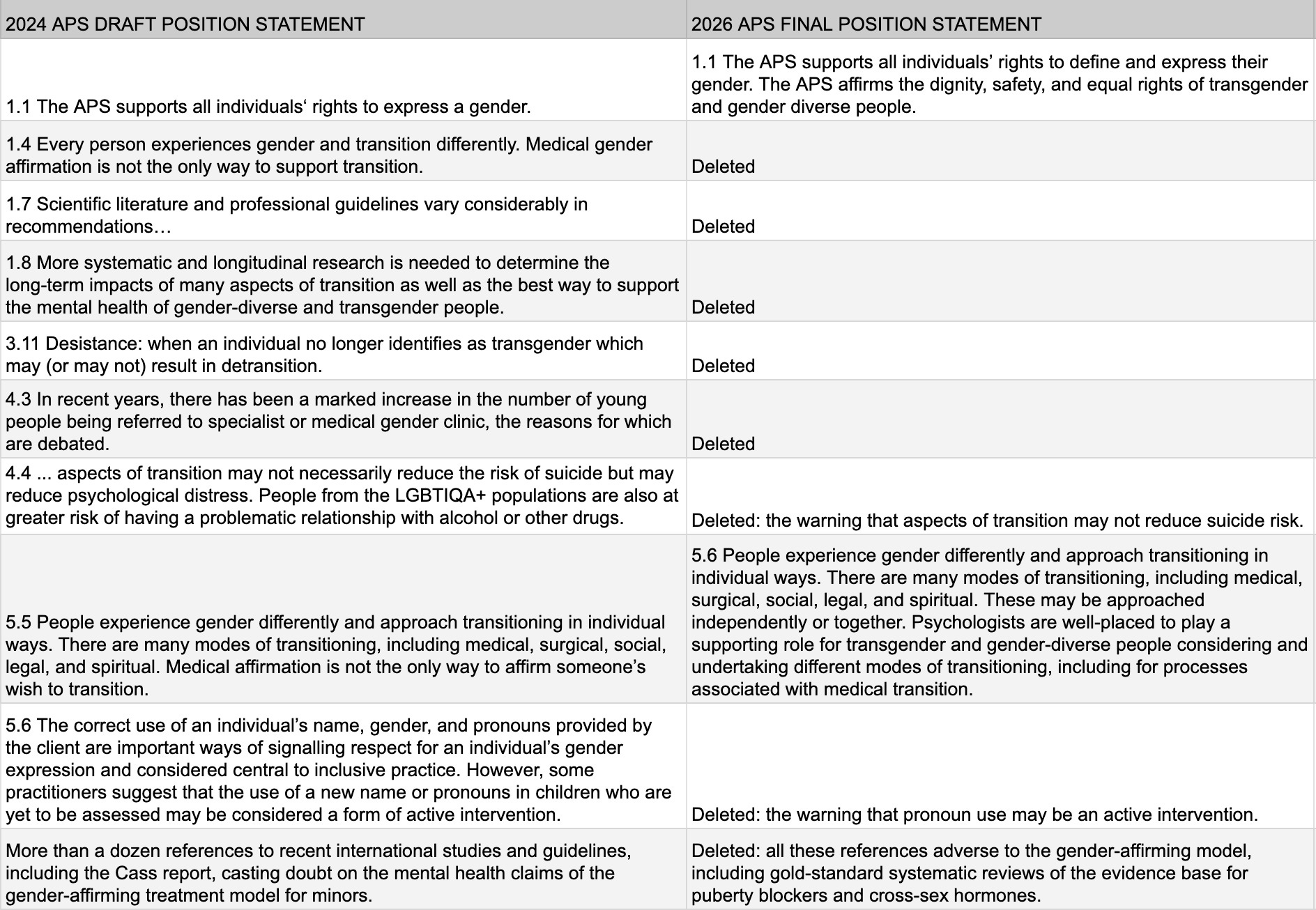
It is fair to say that this final document is an insult to the taskforce members who spent their time and energy working towards a genuine consensus document. Instead, it appears that revisions by the genders and sexualities interest group have taken the APS back to the position where the taskforce started. The exercise has been a total waste of time and is a betrayal of APS members who are aware of the flaws in the gender-affirming model.
Back to affirmation: tweaks and deletions from the draft statement to its final form
Doublethink
The ability of members of the genders and sexualities interest group to tolerate cognitive dissonance is stunning. On the one hand, for example, they insist on immediate affirmation, on the other hand the position statement says—
“As with all clients, a thorough psychological assessment and case formulation is recommended to gain a comprehensive understanding of acuteness of distress, socio-cultural background, as well as risk and protective factors and differential diagnoses.
“Treatment approaches to address psychological distress should be discussed clearly and openly with the client.”
It is worth noting that 55 per cent of detransitioners in a 2021 survey said clinicians didn’t give adequate medical evaluation before gender transition.
Despite the seriousness of this issue, I couldn’t help being amused by the “Disclaimer and copyright” section that appears on page two of the new APS document. It is quite common for a disclaimer to be included in position statements. The Royal Australian and New Zealand College of Psychiatrists (RANZCP) followed common practice:
“Disclaimer: This information is intended to provide general guidance to practitioners, and should not be relied on as a substitute for proper assessment with respect to the merits of each case and the needs of the patient.
“The RANZCP endeavours to ensure that information is accurate and current at the time of preparation, but takes no responsibility for matters arising from changed circumstances, information or material that may have become subsequently available.”
The APS has taken the concept of a disclaimer to a whole new level. Their text denying future liability says—
“This publication was produced by The Australian Psychological Society Ltd (APS). The information provided is general in nature and does not replace individual professional clinical assessment, judgement and decision making. Although every reasonable effort has been made to ensure the accuracy of the information, no guarantee can be given that the information is free from error or omission.
“The APS, its officers, employees, and agents will accept no liability for any act or omission occurring from reliance on the information provided, or for the consequences of any such act or omission. The APS does not accept any liability for any injury, loss, or damage incurred by use of or reliance on information in this document. Such damages include, without limitation, damages that might be regarded as direct, indirect, special, incidental, or consequential.
“Any reproduction of this material must acknowledge the APS as the source of selected passage(s), extract(s), or other information or material reproduced. For reproduction or publication beyond that permitted by the Copyright Act 1968 (Cth), permission should be sought in writing.”
One of the triggers for setting up the taskforce was to provide clear, evidence-based guidelines for APS members who worked with gender-questioning young people, so they would have a solid defence in the event of a complaint against them. This was the whole point of my letter to the APS in September 2021.
A common grievance of dissatisfied clients is that the clinician did not spend time on an assessment but simply affirmed their belief they were transgender in the first session. With this in mind, I naively assumed that an in-depth assessment would be mandatory in the new APS document. Instead, proper assessment comes across as just a possible option, outweighed by the dogma that if a client says they are trans, they are trans, and must be affirmed immediately, for example, by asking them their pronouns.
For me, the whole point of the taskforce was to stress the importance of making every effort to identify the safest outcome for each individual client. This position statement falls far short of that goal. And the disclaimer sends a clear message to psychologists—the APS does not have your back.
Dr Sandra Pertot retired not long ago after 50 years of practice as a clinical psychologist specialising in human sexuality, including sexual dysfunction, sexual orientation and gender diversity

Prior to the early 2000’s there was essentially no childhood gender dysphoria in Australia, or the rest of the world for that matter.
Everybody seemed to get on just fine with their god given genitals.
It is well established that the Affirmative Model of Gender Care is not evidence based – so perhaps there is no need to agonise over what ‘evidence-based advice’ we can replace it with.
Just shut it all down.
How disappointing of the APS. Thankyou Sandra for everything you do.